Who Did Here I Go Again
The story backside Whitesnake's Here I Get Again
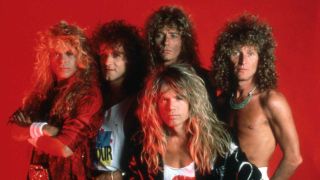
In a sense in that location are two Whitesnakes, both of which command affection and respect, and Whitesnake fans tend to autumn into two groups. There are followers of the dejection-rock group's gutsy first incarnation, formed by David Coverdale in March 1978. Others prefer the line-up the former Deep Royal vocaliser put together for his crusade to conquer America that began during the middle of the 80s.
On paper, the two versions of the band have piffling in common. Coverdale brought in the early Whitesnake for their musical expertise and uniform personalities. Guitar mainstays Bernie Marsden and Micky Moody were long gone when 1984's Slide Information technology In anthology was released in the U.s., with ex-Thin Lizzy guitarist John Sykes brought on lath to heave the grouping'south 'centre processed' factor. Bassist Neil Murray was as well re-hired (briefly), although he was the sole reminder of the Whitesnake line-up that some people even so regard as definitive.
A new, epitome-friendly Whitesnake was almost to brand an attack on the The states charts. Hairstyles and MTV-friendly line-ups aside, the transition owed much to two songs, both recorded past the original Whitesnake. The 2d of these was Fool For Your Loving, a 1980 anthem controversially reworked ix years subsequently past a line-upwardly that included, perhaps ill-fittingly, Steve Vai on guitar.
But the song that really established Whitesnake in America was Here I Go Again. As a single from the Saints & Sinners album, it reached No. 34 in the Uk in 1982. Merely when Geffen Records requested a US single for the 1987 album five years later, a revised accept of Hither I Go Again became the ring's outset American chart-topper (it also squeezed into the British Top ten).
The vocal has always been jointly credited to guitarist Bernie Marsden – a band member between 1978 and 1983 – and Coverdale, although the latter has since offered several differing accounts of his office in writing it.
"I've read that David wrote information technology after his marriage broke up, or that it was written on a boat in Venezuela, which e'er mystified me," Marsden says. "It actually began as a two-track demo at my old house in Buckingham, with the opening line 'I don't know where I'chiliad going', the chorus and the riff. It existed towards the end of the sessions for the previous album, Come An' Become It [in 1981], and we tried to record it at Rock City in Shepperton. Simply it was during the sessions at Clearwell Castle that the song really took shape."
Co-ordinate to Marsden, upon hearing its musical framework Coverdale "disappeared with the cassette", and the lyrics were completed "in almost an hour".
Despite the obvious quality of Here I Go Again, Saints & Sinners wasn't an easy record to make. In January 1982 Coverdale read the riot act to the ring, and at i point even pulled the plug, fed upward with attitudes. "People were content to cruise on gold status," Coverdale said shortly afterward. At its conclusion, Moody walked out. Then in May, wages were frozen.
Past the time Whitesnake #5 came together in the summer, Moody had been reinstated, and Marsden replaced by Mel Galley, the ex-Trapeze guitarist who had sung backing vocals on the album.
"Saints & Sinners was made nether difficult circumstances, specially when Micky left," Marsden says. "But it's a remarkably good album. It was a shame nobody except for David was fully credited on the sleeve."
Moody's sorrow at leaving the band was compounded when Hither I Go Again "grew its other caput", as Marsden puts information technology. "I'd asked him for some help on the span, merely he wanted to scout the football," he grins. "Micky now reckons he could've bought Chelsea had he given me that 90 minutes."
Likewise equally a markedly slicker sound, the US version inverse the original line 'Like a hobo I was born to walk alone' to 'Like a drifter', to avert confusion with the word 'homo'.
Although Marsden has derided the Vai-enhanced version of Fool For Your Loving, he is more conciliatory towards Coverdale'south revision of Here I Go Again: "It was a great version," Marsden says. "John Kalodner [Geffen Records A&R 'guru'] was perfectly right when he predicted it would be a The states number 1."
This feature originally appeared in Classic Rock 87, in November 2005.
Source: https://www.loudersound.com/features/the-story-behind-whitesnakes-here-i-go-again
0 Response to "Who Did Here I Go Again"
Post a Comment